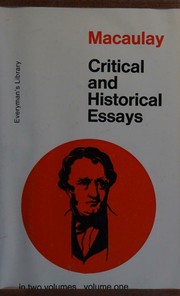
- Andrew Carnegie: "In this way I became familiar with Macaulay's essays and his history, and with Bancroft's 'History of the United States,' which I studied with more care than any other book I had then read." source ↗
Thomas Babington Macaulay's collection of essays originally published in the Edinburgh Review between 1825 and 1844, covering literary figures (Milton, Bacon, Addison, Dryden), historical subjects (Hallam's Constitutional History, Ranke's History of the Popes, the life of Warren Hastings), and political and philosophical controversies including the Utilitarianism of James Mill. The essays established Macaulay's literary reputation before his History of England and remain models of the English essay form — confident, prosecutorial in their argumentation, and vividly portraiture.
Carnegie read Macaulay's essays and history from Colonel Anderson's library as a teenage messenger boy, and the essays are arguably more relevant to a founder than the history. They show Macaulay's method of intellectual combat: take a position, assemble evidence with devastating clarity, and prosecute the argument until the opposition's case collapses. For a founder building narrative advantage — whether in fundraising, recruiting, or market positioning — Macaulay demonstrates how to make a case so effectively that the reader wonders how anyone could disagree. The essays also cover the thinkers and movements that shaped the intellectual environment Carnegie operated in. Reading Macaulay on Francis Bacon, for instance, is reading the 19th century's most celebrated essayist on the philosopher who most influenced the scientific and industrial revolution Carnegie himself drove. Macaulay taught Carnegie that a well-constructed argument is itself a form of power — a lesson every founder needs.