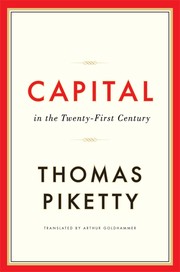
- Bill Gates: "The debate over wealth and inequality has generated a lot of partisan heat. I don’t have a magic solution for that. But I do know that, even with its flaws, Piketty’s work contributes at least as much light as heat." source ↗
Thomas Piketty's 2013 study of wealth and income inequality across Europe and the United States since the 18th century, first published in French by Éditions du Seuil, with an English translation by Arthur Goldhammer published by Harvard University Press in 2014. Its central thesis — that when the rate of return on capital (r) exceeds economic growth (g), wealth concentrates — became the most discussed economic argument of the decade. The book sold over 2.5 million copies by 2017.
Gates reviewed the book on Gates Notes, writing: "The debate over wealth and inequality has generated a lot of partisan heat. I don't have a magic solution for that. But I do know that, even with its flaws, Piketty's work contributes at least as much light as heat." The measured endorsement — acknowledging the book's data errors and methodological criticisms while still recommending it — is typical of how Gates engages with complex social science.
For a founder, Piketty is useful in two ways. First, the r > g framework is a structural argument about the environment any company operates in: when capital returns outpace economic growth, the value of existing assets grows faster than the value of new production, which affects everything from fundraising dynamics to acquisition strategy. Second, the book's reception itself is instructive — Piketty's data was challenged by the Financial Times, triggering a public debate that played out in real time, a useful case study in how empirical claims in economics are tested, defended, and refined.