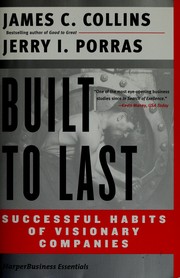
- Jeff Bezos — Named his favorite business book in a 2001 Fast Company interview: "My favorite business book is Built to Last." source ↗
Jim Collins and Jerry Porras's 1994 management classic, a six-year study of eighteen companies that have outperformed their peers for decades — including 3M, Boeing, Disney, Hewlett-Packard, Merck, Procter & Gamble, Sony, Wal-Mart, and others. Collins and Porras argue that the most enduring companies are distinguished not by a great idea or a charismatic leader but by a core ideology (a timeless set of values and purpose), a strong culture, and a willingness to pursue 'Big Hairy Audacious Goals' (BHAGs) that stretch the organisation beyond its current capabilities.
Bezos named this his favourite business book in a 2001 Fast Company interview. The shelf entry records the exact words: 'My favorite business book is Built to Last.' The book's concept of 'clock-building, not time-telling' — building an organisation that can produce great products and leaders long after the founder is gone — maps directly onto the job Bezos set himself at Amazon: constructing the flywheel, the institutional mechanisms (the six-page memo, bar-raiser hiring, the PR/FAQ), and the leadership principles that turned a Seattle bookstore into an infrastructure company.
For a founder, the distinction between 'time-telling' (having one great insight) and 'clock-building' (building an organisation that produces great insights repeatedly) is the single most important frame in the book. The BHAG framework — a goal so ambitious that the organisation cannot reach it through incremental improvement — is the same tool Musk uses when he sets deadlines nobody believes to force a different approach. Collins and Porras show that the visionary companies did not start with a great idea; several of them started as failures (3M began as a failed corundum mine; Sony sold rice cookers before radios) and found their purpose later through experimentation and persistence.