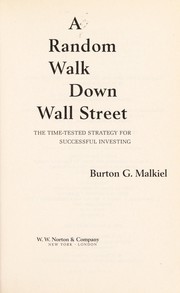
- John Bogle: "Professor Malkiel's work helps solidify the intellectual basis for my personal favorite investment, the index fund." source ↗
A Random Walk Down Wall Street is Burton Malkiel's classic 1973 exposition of the efficient-market hypothesis, arguing that stock prices follow a random walk and cannot be consistently predicted by any method — technical analysis, fundamental analysis, or chart reading. Malkiel makes the case that the rational investor's best strategy is to buy and hold a broadly diversified index fund. The book has gone through more than a dozen editions and remains the most widely read argument for passive investing.
Bogle placed this on his must-read list with a direct endorsement: 'Professor Malkiel's work helps solidify the intellectual basis for my personal favorite investment, the index fund.' The book is the academic bedrock of Bogle's entire philosophy — Malkiel provides the theory; Bogle provides the implementation.
For founders, the book's value goes beyond investing. Malkiel's argument that expert predictions are systematically unreliable is directly transferable to business: the same overconfidence that makes stock pickers lose money also makes founders overestimate their ability to predict market outcomes. Senra draws a parallel between Malkiel's critique of active fund management and the startup pattern of 'fake it till you make it' forecasts — both rely on the illusion that the future is knowable when the data says it is not.
The random walk hypothesis is also a useful corrective for founders prone to narrative thinking: the market (and by extension, the competitive environment) is noisier and less predictable than any story about it can capture. The practical takeaway is not passivity — Bogle and Malkiel both emphasize that long-term compounding is anything but passive — but humility about short-term control.