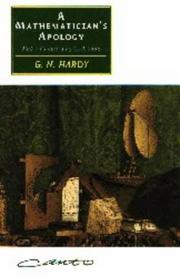
- Paul Graham: "This idea I learned from Hardy’s A Mathematician’s Apology, which I recommend to anyone ambitious to do great work, in any field." source ↗
G. H. Hardy's 1940 defense of mathematics as a pure, creative art — a discipline pursued not for utility but for beauty, like painting or poetry. Written as an aging mathematician felt his powers fading, it argues that a mathematician's work, like an artist's, should be judged by its elegance and permanence, not its applications. Hardy famously claimed that 'a science is said to be useful if its development tends to accentuate the existing inequalities of wealth, or more directly promotes the destruction of human life,' and prized the 'real' mathematics of Gauss and Ramanujan over the 'trivial' mathematics that wins wars.
Graham recommends it in 'How to Do Great Work' with direct endorsement: 'This idea I learned from Hardy's A Mathematician's Apology, which I recommend to anyone ambitious to do great work, in any field.' In 'Taste for Makers,' he frames Hardy's epigraph — 'Beauty is the first test: there is no permanent place in this world for ugly mathematics' — as evidence that aesthetic judgment steers technical judgment, not merely decorates it. 'He means the same thing Kelly Johnson did: if something is ugly, it can't be the best solution.'
For a founder, Hardy's core argument is a defense of working on what fascinates you regardless of immediate applicability. The Apology is brief (153 pages) and its lesson is not its mathematics but its attitude: that the serious pursuit of difficult, beautiful work is justification enough. Graham calls this idea foundational to his own career. The book also contains the origin of the bus-ticket theory of genius — Hardy's observation that Ramanujan's 'natural mathematical genius' was inseparable from an obsessive, almost pathological interest in numbers that looked like pointless labor to everyone else.