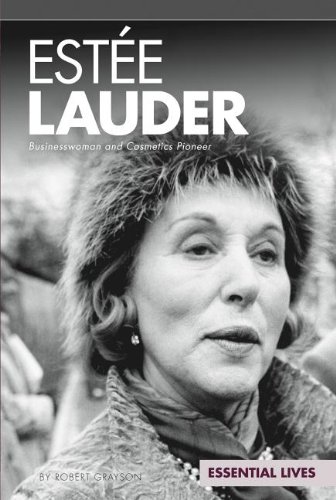
Part of the young-adult 'Essential Lives' series, this concise, heavily illustrated biography by Robert Grayson lays out the basic facts of Estée Lauder's life and career: her upbringing as Josephine Esther Mentzer, daughter of Jewish immigrants in Queens; how she learned skin-cream formulas from her chemist uncle; her early door-to-door and counter-top selling; and her build-out of a home-based cream business into a global cosmetics company. The book includes a timeline, glossary, and fact pages aimed at giving younger readers a straightforward, factual overview rather than a critical or narrative-driven account.
David Senra's Founders podcast covered Estée Lauder's own memoir, 'Estée: A Success Story,' across episodes #136 and #361, and this book's plain factual retelling reinforces the same core arc in more compressed form: an unknown founder with no retail relationships who forced her way into the market through sheer persistence. Grayson's account is useful precisely because it strips the story down to verifiable facts — where a memoir can shade toward myth-making, a reference-style biography lets founders see the timeline of the hustle without the polish.
What comes through clearly even in this condensed version is that Lauder's early growth came entirely from unscalable, founder-led selling: standing at department store counters demonstrating products on customers' hands, refusing to leave until stores agreed to carry her line, and giving away free samples aggressively before anyone else in the industry did. For founders, the lesson is that before a brand has any pull of its own, someone has to manually create every early customer relationship — there is no shortcut around that phase.
The book also documents how central family was to the company's structure for decades, with her husband and sons in key operating roles, showing founders that an early, trusted inner circle — even an informal, family-based one — can substitute for the systems a larger company would need later.