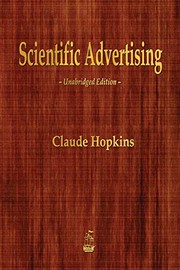
- David Ogilvy: "Nobody, at any level, should be allowed to have anything to do with advertising until he has read this book seven times." source ↗
Published in 1923, Scientific Advertising is Claude Hopkins's short, dense manual arguing that advertising should be treated as a measurable science rather than an art of persuasion. Hopkins, widely regarded as the father of modern advertising and direct-response copywriting, pioneered techniques like split-run testing (an early form of A/B testing) and trackable coupon codes to measure exactly what worked. The book distills what he learned from decades of testing headlines, offers, and claims against real sales data.
Hopkins's core claim, "advertising is salesmanship," is the book's whole argument in four words: every principle that makes a good salesman effective in person should govern what you write and how you test it. He insists on specificity over vague superiority claims — a decades-old example is his Schlitz beer campaign, where he described the exact process of sterilizing bottles in "live steam," a step every brewer did but none advertised, and it made a stagnant brand competitive almost overnight. The lesson for founders is that differentiation often isn't invented, it's discovered by describing your actual process more precisely than anyone else bothers to.
David Senra covered this book on Founders as a companion to his episode on Albert Lasker, Hopkins's longtime partner, framing Hopkins as someone who treated every ad as an experiment: track results, kill what doesn't convert, scale what does. For a founder, that's a direct model for marketing (and really any go-to-market decision) as a testing discipline rather than a matter of taste or opinion.