- James Dyson: "Breakthrough inventions hardly ever come from completely new ideas, but rather from the application of a concept from one field to another. The cyclonic vacuum cleaner was inspired by the way industrial cyclones spun dust and dirt out of the air." source ↗
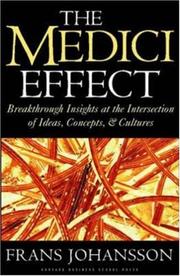
The Medici Effect argues that history's biggest breakthroughs happen not within a single discipline but at the intersection of different fields, cultures, and ways of thinking. Frans Johansson takes the name from the Medici banking family of Renaissance Florence, whose patronage brought sculptors, scientists, poets, and financiers into the same city, sparking an explosion of innovation. The book lays out why intersectional thinking generates more novel combinations than incremental improvement inside one domain, and offers a framework for deliberately putting yourself at that intersection.
For founders, the core lesson is that the best startup ideas rarely come from going deeper into a single specialty — they come from forcing together concepts that have never been in the same room before. Johansson's framework is a direct argument against overspecialization: a founder who only reads industry blogs and only talks to people in their own field is starving their own idea generation. The book pushes founders to actively curate an "intersection" for themselves — diverse teams, cross-industry reading, unfamiliar cities, unrelated hobbies — because that's where the non-obvious, hard-to-copy ideas surface.
The book also reframes what looks like a disadvantage — not being a domain expert — as an asset. Outsiders bring associative combinations that insiders can't see because they're anchored to the field's existing assumptions. Founders entering a new industry without a pedigree in it should read this as permission, and a method: seek out the deliberate collision of ideas rather than deference to conventional expertise.
Practically, it argues for building teams and networks on purpose for diversity of background rather than similarity, since homogenous teams tend to converge on the same associative networks and miss combinatorial insights. It's less a tactical playbook and more a mental model for where innovation actually originates — useful for founders deciding where to spend their curiosity.