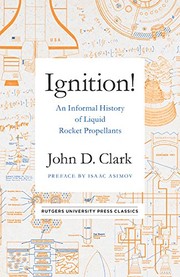
John D. Clark's 1972 informal history recounts the Cold War-era search for viable liquid rocket propellants, drawn from his own career as a propellant chemist at the Naval Air Rocket Test Station and later Picatinny Arsenal's Liquid Rocket Propulsion Laboratory. Part memoir and part technical history, it chronicles a small, tight-knit community of chemists testing extraordinarily volatile and hazardous fuel-oxidizer combinations, many of which exploded, corroded, or detonated on contact, in pursuit of propellants stable and powerful enough to eventually put satellites and astronauts into space. The book carries a foreword by Isaac Asimov, a friend and colleague of Clark's.
Clark's book is a long-standing favorite of hard-tech founders, including Elon Musk, precisely because it documents what real frontier engineering looked like before there was a playbook: relentless, dangerous, and largely undocumented trial-and-error carried out by a small group willing to risk their lives on chemistry nobody had proven safe. There was no shortcut around the experimentation — compounds had to be mixed, tested, and often literally blown up before anyone knew which combinations were survivable, let alone useful.
The book is a useful corrective to the myth of the singular breakthrough. Rocket propulsion did not advance through one brilliant insight but through years of accumulated near-misses, failed formulations, and hard-won institutional knowledge inside a community that shared results even as they competed. For founders building in genuinely novel technical territory, it's a reminder that progress in deep-tech is rarely a straight line from idea to product — it's an accumulation of small, often destructive experiments that nobody could have shortcut with more upfront analysis.
Clark's dry, unsentimental honesty about how much risk the work demanded — described in Asimov's foreword as learning to 'cuddle with death every waking moment' — also speaks to the organizational risk tolerance genuine frontier R&D requires. Founders trying to build something that has never been built before can read this as a case study in what it actually costs, in nerve and tolerance for failure, to work at the edge of what's known.