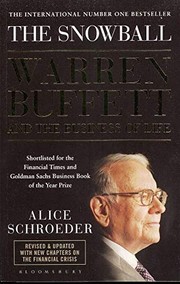
Alice Schroeder's authorized biography of Warren Buffett draws on hundreds of hours of personal interviews and access to Buffett's private files to trace his life from a childhood obsessed with numbers and money-making schemes in Omaha to becoming one of the richest people in the world. It covers his partnership years, the acquisition and transformation of Berkshire Hathaway, his key relationships with Charlie Munger, Susan Buffett, and Katharine Graham, and the compounding of both his fortune and his reputation over more than seven decades.
David Senra covered The Snowball as Founders episode #100, and the title itself is the lesson he keeps returning to: Buffett's entire life is a demonstration of compounding, not just of capital but of reputation, relationships, knowledge, and skill. Senra frames Buffett's early decades — the paper routes, the pinball machines, the relentless reading of 10-Ks — as proof that founders should start their snowball rolling as early and as often as possible, because the size of the snowball at the end depends less on any single decision than on how many years it has been rolling downhill.
The book is also a study in obsessive focus and circle of competence. Buffett read constantly, said no to almost everything outside his expertise, and built his advantage by simply being more rational and more patient than everyone else in the room. Founders should take from this that edge often comes not from genius insight but from sustained, boring discipline applied over a much longer time horizon than competitors are willing to tolerate.
Schroeder's access also surfaces the less flattering parts — Buffett's difficulty with intimacy, his workaholism, and the personal costs of a life organized entirely around one pursuit. Senra treats this candidly: the same singular focus that builds an empire can hollow out a personal life, and founders modeling themselves on figures like Buffett should decide deliberately what they are willing to trade for the compounding.