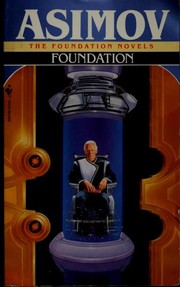
Isaac Asimov's 1951 novel, assembled from five interlinked stories originally published in the 1940s, opens the Foundation series. Mathematician Hari Seldon develops 'psychohistory,' a fictional science that predicts the behavior of large populations with statistical precision even though individuals remain unpredictable, and uses it to foresee the collapse of the 30,000-year Galactic Empire. Unable to prevent the fall, Seldon establishes a Foundation at the edge of the galaxy and pre-plans a series of crises for it to survive, designed to compress the coming dark age from thirty thousand years down to one thousand.
Foundation is one of the most cited science-fiction novels among technology founders, and its influence is explicit rather than incidental: Elon Musk has repeatedly named it as formative, has described wanting to extend the life of civilization the way Seldon's Foundation shortens the galaxy's dark age, and Walter Isaacson's biography of Musk draws a direct line between Seldon's plan and Musk's own long-horizon thinking about SpaceX and humanity's survival. Several tech leaders have cited the book by name when explaining why they think in centuries rather than quarters.
The central device — psychohistory predicting aggregate outcomes from populations too large and too statistically stable to reason about individual by individual — is a useful mental model for founders operating at scale: you cannot predict what any single customer will do, but market-level behavior across millions of users can be modeled with real precision, which is part of why the book resonates with people building on large datasets and network effects.
The novel's structure of recurring 'Seldon Crises' — moments where the Foundation's survival looks impossible until the only viable path forward turns out to be the one Seldon anticipated — is also read by founders as a case for scenario-planning and pre-mortems: doing the work in advance to imagine how an organization survives its future crossroads, rather than improvising from zero when the crisis actually arrives.