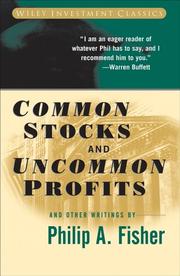
- Warren Buffett: "Phil Fisher put it wonderfully 54 years ago in Chapter 7 of his Common Stocks and Uncommon Profits, a book that ranks behind only The Intelligent Investor and the 1940 edition of Security Analysis in the all-time-best list for the serious investor." source ↗
Philip Fisher's 1958 investing classic argues that the biggest returns come not from bargain-hunting on price but from identifying exceptional, well-managed growth companies and holding them for the long term. It introduces his "fifteen points to look for in a common stock" and the "scuttlebutt method" of researching a business by talking to its customers, competitors, suppliers, and former employees rather than relying solely on financial statements.
Fisher wrote this as an investor's manual, but founders get as much out of it as buyers of stock, because his fifteen points are really a checklist for what makes a company worth building. He weights sales and profit growth potential, R&D depth, sales organization strength, and margins above almost anything else — a reminder that a founder's job is to construct a business that would pass Fisher's own scrutiny, not just to raise the next round.
The single point Fisher refuses to compromise on is management integrity — he argues that no amount of growth potential matters if the people running the company will not treat shareholders and employees honestly. For a founder, that reads as a mandate about the culture and character they build into the company from day one, since it eventually gets stress-tested by outsiders exactly the way Fisher's scuttlebutt method tests it.
His broader philosophy — buy rarely, hold for decades, resist the urge to trade on short-term noise — maps directly onto how founders should think about their own equity and their own company: conviction built from real diligence, not price action, and patience measured in years rather than quarters. Warren Buffett has said Fisher's approach shaped 15% of his own investing framework (with Ben Graham the other 85%), which is part of why this book keeps surfacing in founder and investor reading lists alike.