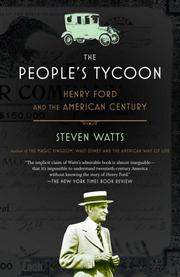
Steven Watts's 2005 biography traces Henry Ford's rise from a Michigan farm boy to the creator of the moving assembly line and the Model T, and one of the richest men in American history. Watts portrays Ford as a bundle of contradictions: a man who paid workers a then-unheard-of $5 day and cut prices to put cars within reach of ordinary Americans, while fiercely opposing unions, romanticizing a rural past he had helped destroy, and descending into virulent antisemitism later in life. The book covers Ford's early tinkering years, the founding and explosive growth of Ford Motor Company, his uneasy relationship with fame, and his complicated legacy as both a democratizer of consumer goods and a reactionary cultural figure.
David Senra returns to Henry Ford repeatedly on Founders podcast as one of the clearest examples of a founder obsessed with a single idea for decades before the world caught up — Ford failed twice at earlier car companies before founding Ford Motor Company, and Watts's account shows how that early failure sharpened rather than dulled his conviction that cars should be simple, durable, and cheap enough for the masses. The founder lesson Senra draws out is that Ford didn't invent the automobile or even the assembly line concept from nothing; he obsessively simplified and re-engineered an existing idea until the economics worked, which is a repeatable model for founders trying to make something already possible into something affordable.
Watts is also unusually good on Ford's instinct for vertical integration and cost obsession — the $5 day wasn't altruism alone but a calculated move to reduce turnover and let workers afford the cars they built, tying labor strategy directly to market expansion. Founders can take from this the idea that a single bold operational decision can simultaneously solve a retention problem and grow your addressable market.
The book is equally valuable as a cautionary tale: Ford's refusal to evolve the Model T, his growing paranoia and control over the company, and his descent into conspiratorial thinking show how the same stubborn conviction that builds an empire can calcify into an inability to adapt once the market moves on. Founders should read Ford's later years as a warning about mistaking past success for permanent rightness.