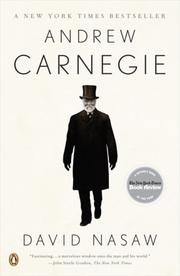
David Nasaw's 2006 biography, a finalist for the 2007 Pulitzer Prize, draws on previously unpublished chapters of Carnegie's own autobiography, family letters, diaries, and correspondence with presidents and prime ministers to build the most comprehensive account of Carnegie's life to date. It traces his rise from a poor Scottish immigrant to the dominant force in American steel, and unlike Carnegie's own telling, gives full weight to the contradictions in his character — the frugal industrialist who crushed the Homestead strike alongside the philanthropist who gave away nearly his entire fortune.
David Senra's Founders episodes on Carnegie (including the three-part series with Henry Clay Frick, #73 and #75, plus the autobiography episodes #74 and #283) lean heavily on Carnegie's own account, which makes Nasaw's biography the necessary corrective: it documents the gap between the public Carnegie of the Gospel of Wealth, who preached that workers deserved dignity and opportunity, and the private Carnegie who let Frick break the Homestead union by force while he stayed safely in Scotland. For founders, that gap is the real lesson — a founder's stated values and what actually happens on the ground when someone else is running operations can diverge sharply, and the founder still owns the outcome.
Nasaw's access to unpublished material also sharpens the picture of Carnegie's operating principles: obsessive cost accounting down to fractions of a cent, buying up every supplier in his chain rather than depending on middlemen, and building new mills during downturns when materials and labor were cheapest. Where Carnegie's own autobiography tells these as tidy anecdotes, Nasaw shows the calculation and risk-tolerance behind them in more granular detail.
The biography also treats Carnegie's later philanthropic career — the systematic funding of over 2,500 public libraries — as its own kind of enterprise, run with the same rigor and personal control he brought to Carnegie Steel, rather than as a simple act of generosity. That reframes giving away a fortune as a second business built on the same operating instincts as the first.