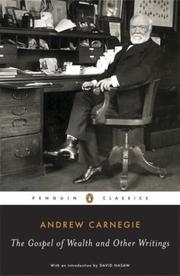
This collection centers on Andrew Carnegie's 1889 essay "Wealth," published in the North American Review and later reprinted as "The Gospel of Wealth," alongside his other essays and writings on business, politics, and philanthropy. Its central argument is that the concentration of wealth under industrial capitalism is a natural outcome of competition, but that the rich are morally obligated to act as trustees of their surplus fortune, distributing it during their own lifetime for the public good rather than passing it to heirs or leaving it to be dispersed after death.
David Senra returns to Carnegie's philosophy repeatedly on Founders (across the Carnegie/Frick episodes and both autobiography episodes, #74 and #283), and the line he keeps coming back to is Carnegie's own: "the man who dies thus rich dies disgraced." For founders building toward an eventual exit or fortune, the essay is Carnegie's answer to a question most founders don't think about until it's too late — what happens to the capital after the company is sold — and his answer is that the founder who built the wealth is also the person best positioned to deploy it well, better than the state or an heir would.
The essay lays out three ways to dispose of surplus wealth — leave it to family, leave it to be distributed after death, or give it away while still alive — and Carnegie argues strongly for the third, on the grounds that only the person who earned the money has the judgment and accountability to see it used wisely. That's a distinctly founder-shaped argument: it treats philanthropy as a project to be run with the same personal oversight as a business, not a check to be written and forgotten, and it's the reasoning that led Carnegie to fund and personally direct the building of over 2,500 public libraries rather than simply endowing a fund.
It's worth reading with the same skepticism Nasaw's biography invites: Carnegie wrote this in 1889, the same period his own company was suppressing wages and, three years later, crushing the Homestead strike. The gap between the essay's high-minded trusteeship rhetoric and Carnegie's treatment of his own workforce is a caution for founders about letting public philosophy substitute for accountability in how a company actually treats people.