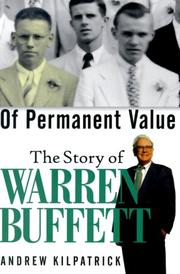
Andrew Kilpatrick's Of Permanent Value is a sprawling, exhaustively detailed chronicle of Warren Buffett's life and investing career, first published in 1994 and periodically expanded into a massive multi-volume reference work running well over a thousand pages. Organized in short, anecdote-driven chapters rather than a single narrative arc, it compiles Buffett's childhood, the Buffett Partnership years, the growth of Berkshire Hathaway, his annual shareholder letters and meeting commentary, and quarter-by-quarter detail on his major investment decisions.
Where Schroeder's Snowball and Lowenstein's Buffett offer a shaped narrative, Kilpatrick's book functions more like a reference encyclopedia — hundreds of short chapters and data points a founder can mine for specific situations rather than a single argument to absorb cover to cover. Its value to founders is in the density of small, concrete examples: how Buffett handled a particular acquisition negotiation, what he said in a specific shareholder letter, how he reacted to a specific market downturn. For founders who already know the broad Buffett story, this is the book you keep on the shelf to look something up rather than the one you read straight through.
The recurring theme Kilpatrick's title itself signals — permanent value — is that Buffett measured decisions against a multi-decade horizon rather than quarterly performance. Founders can take from the sheer accumulation of anecdotes a pattern: consistency of philosophy applied thousands of times, across market cycles both euphoric and brutal, is what actually compounds. No single decision in the book looks especially dramatic; the effect only becomes visible in aggregate, which is itself a lesson about how founders should evaluate their own long-run consistency rather than any individual quarter's results.