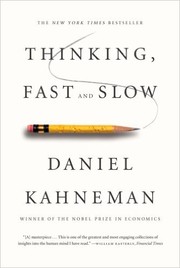
- Marc Andreessen: "Captivating dive into human decision making, marred by inclusion of several/many? psychology studies that fail to replicate. Will stand as a cautionary tale?" source ↗
Daniel Kahneman's 2011 magnum opus summarizes a lifetime of research, much of it with Amos Tversky, on how the human mind makes decisions. Kahneman divides cognition into two systems — System 1 (fast, intuitive, emotional) and System 2 (slow, deliberate, logical) — and shows how each leads us astray in predictable ways through cognitive biases, heuristics, and framing effects. The book is the canonical text of behavioral economics and decision science.
Andreessen gives a characteristically nuanced take: "Captivating dive into human decision making, marred by inclusion of several/many? psychology studies that fail to replicate. Will stand as a cautionary tale?" The question mark is the insight: Andreessen reads it as both the definitive compendium of how thinking goes wrong AND a document of a field whose own methodology turned out to be less reliable than advertised.
For a founder, System 1 vs System 2 is immediately operational. Every decision a founder makes (hire, fire, pivot, raise, price, partner) occurs under conditions of uncertainty, time pressure, and emotional intensity that maximize System 1's influence. The specific biases that kill startups — overconfidence (planning fallacy), anchoring on sunk cost (escalation of commitment), availability bias (reacting to the most vivid data point) — are diagnosed in these pages with precision. Building a decision process that forces System 2 engagement — premortems, written decision memos, red teams, prediction tracking — is a direct application. But Andreessen's caveat about replication is also a founder lesson: the tools you use to make decisions are themselves fragile, and you should hold them as cautiously as you hold your own intuitions.