- Marc Andreessen: "Two more books on who we are and how we got here, one on culture, the other on genetics." source ↗
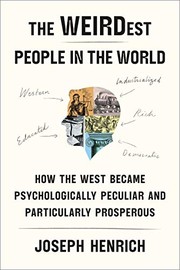
Joseph Henrich's 2020 book argues that Western societies are psychologically unusual by global standards — WEIRD (Western, Educated, Industrialized, Rich, Democratic) — and that this peculiar psychology was largely produced by the medieval Catholic Church's marriage and family policies. Henrich shows that the Church's prohibition on cousin marriage, its promotion of the nuclear family, and its dismantling of kin-based institutions created the individualistic, analytical, and trust-outside-kin psychology that ultimately enabled modern science, democracy, and economic growth.
Andreessen groups it with David Reich's book as "two more books on who we are and how we got here, one on culture, the other on genetics." The pairing is the whole point: Henrich explains the cultural lineage of Western innovation, Reich the biological one.
The founder insight is Henrich's explanation of why Western institutions — markets, corporations, democratic governance, scientific inquiry — work the way they do and where they come from. The psychology that makes Silicon Valley possible (stranger trust, independent thinking, willingness to join voluntary organizations, analytical reasoning about abstract systems) is not universal human nature — it is a historically contingent cultural product of specific institutions, specifically the Church's assault on kinship structures. For a founder operating globally, this is a crucial reminder that the institutional assumptions you take for granted — contract enforcement, intellectual property, collaborative innovation, impersonal exchange — are culturally specific and cannot be assumed to travel. The book also explains why immigrant founders are so powerful: they are the WEIRD products of their Western education, carrying the psychology of innovation into contexts that may not have produced it.