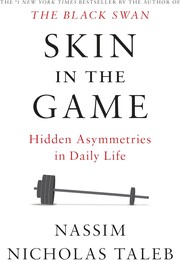
- Marc Andreessen: "Ideal counterpart to @PTetlock's Expert Political Judgment." source ↗
Nassim Nicholas Taleb's 2018 book, the fifth in his Incerto series, argues that any system that separates decision-making from the consequences of those decisions is structurally corrupt. Taleb formalizes the concept of "skin in the game" — the requirement that those who make decisions bear personal risk if those decisions turn out badly. He applies this lens to domains from ancient Hammurabi's code to modern finance, politics, and corporate governance, arguing that the asymmetry between who decides and who pays is the hidden cause of most institutional failures.
Andreessen called this "the ideal counterpart to @PTetlock's Expert Political Judgment," recommending them together. "Skin in the game as conflict of interest, or as attaching one's livelihood to one's speech? Who to listen to, and why." For a founder, the book is a diagnostic tool. Every asymmetry Taleb describes — advisors who recommend strategies they never execute, managers whose bonuses pay out before losses arrive, investors whose downside is capped — is a concrete failure mode that startups are vulnerable to.
Taleb's framework gives a founder a question to ask about every hire, investor, and board member: What do they lose if this goes wrong? The person who shares in the downside thinks differently from the person who only shares in the upside. Founders live skin in the game by definition — their net worth, reputation, and time are all on the line — but early employees, co-founders, and investors may not share the same asymmetry. The book teaches why certain institutional structures — venture capital with carried interest, founder-controlled boards, concentrated ownership — exist: they force alignment of risk. It also warns that the worst decisions are made by people with no personal exposure to the consequences.