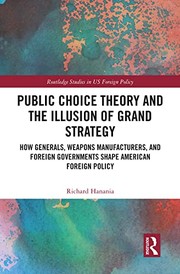
- Marc Andreessen: "Public Choice Theory and the Illusion of Grand Strategy by Richard Hanania -- a sobering reexamination of how democratic governments actually make decisions." source ↗
Richard Hanania's 2021 book applies public choice theory — the economic study of political behavior pioneered by James Buchanan and Gordon Tullock — to the conduct of US foreign policy. Hanania argues that American grand strategy is largely an illusion: government decisions are shaped by self-interested bureaucrats, special-interest capture, and rationally ignorant voters rather than any coherent conception of the national interest. The book synthesizes academic public choice scholarship to explain why democratic governments produce incoherent policy.
Andreessen called this "a sobering reexamination of how democratic governments actually make decisions" — a phrase that captures the core value for a founder. Most founders operate with an implicit theory that good ideas win, that regulators act in the public interest, and that policy is a rational response to problems. Public choice theory explains why none of those things are reliably true. Agencies are captured by the industries they regulate. Bureaucrats maximize budgets and turf. Voters are rationally ignorant because a single vote almost never decides an election.
For a founder trying to disrupt an incumbent industry, this book is the theoretical toolkit for understanding the opposition. When an established industry fights a startup through regulation, zoning, licensing, or standards, it is not a bug. It is exactly what public choice theory predicts: concentrated benefits (the incumbent's profits) defeat diffuse costs (the forgone innovation that consumers never see). Founders who understand regulatory capture can anticipate which industries will fight hardest and whether the better strategy is to bypass, partner, or go to war.