- Marc Andreessen: "on how modern technological economies can build more outputs with less inputs, and why we need all economies to be modern and technological." source ↗
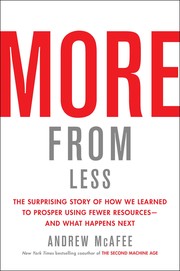
Andrew McAfee's More from Less (2019) argues that technological progress has decoupled economic growth from resource consumption: the United States and other advanced economies now use fewer materials, less energy, and less land to produce more value every year. McAfee, a principal research scientist at MIT and co-author of The Second Machine Age, marshals data on timber, steel, water, fertilizer, and carbon emissions to demonstrate that "peaking" — the point where resource use begins to decline while GDP continues to rise — has already occurred across multiple dimensions, driven by capitalism, innovation, and public awareness.
Andreessen recommended this in his "It's Time to Build" reading list, describing it as being "on how modern technological economies can build more outputs with less inputs, and why we need all economies to be modern and technological." For a founder, the book is the strongest available empirical argument for technological optimism — the thesis that the best environmental strategy is not degrowth but acceleration. If using less stuff requires better technology, and building technology requires market incentives, then the founder building a technology company is participating in the solution, not the problem.
McAfee's data challenges the assumption — widespread among regulators, journalists, and voters — that economic growth and environmental destruction are linked. For a founder whose product or business model faces regulatory headwinds based on that assumption, More from Less provides the ammunition to argue the opposite: the fastest way to reduce resource consumption is to make the economy more technologically advanced, which is exactly what startups do. The book is the intellectual underpinning for the "build more of everything" thesis Andreessen has been articulating since 2020 — more technology, more capitalism, more growth, and measurably less environmental impact per unit of output.