- Marc Andreessen: "Is the future knowable, and by whom? All pundits and commentators should publish their prediction track records, yet don't. What to pay attention to and what to ignore." source ↗
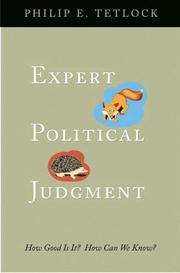
Philip E. Tetlock's Expert Political Judgment (2005) is a landmark study in political psychology that tested the predictive accuracy of hundreds of experts over two decades and found that most performed worse than simple statistical baselines. Tetlock, a professor at the University of Pennsylvania who later co-founded the Good Judgment Project, identified two cognitive styles — "foxes" who draw from multiple frameworks and update frequently, and "hedgehogs" who apply a single big idea to everything — and demonstrated that foxes consistently outpredict hedgehogs. The book is the empirical foundation of the modern forecasting movement and a systematic dismantling of credentialed expertise as a predictor of accuracy.
Andreessen introduced it by asking "Is the future knowable, and by whom? All pundits and commentators should publish their prediction track records, yet don't. What to pay attention to and what to ignore." The fox-hedgehog distinction is one of the most practically useful cognitive frameworks a founder can adopt: hedgehog founders who fall in love with one analysis or one strategic bet tend to ignore disconfirming data until too late, while fox founders who maintain multiple hypotheses and track their own track records catch market shifts early.
Tetlock's deeper finding is that expertise as conventionally measured — credentials, media appearances, institutional position — is almost uncorrelated with predictive accuracy. Status and accuracy are different signals. For a founder evaluating advisors, board members, or market forecasts, Tetlock provides a systematic filter: judge by track record honestly recorded up front, not by authority. Andreessen paired this with Taleb's Skin in the Game as its "ideal counterpart" — forecasting without personal exposure to consequences is a fundamentally different game.