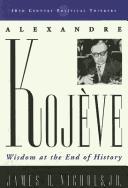
- Marc Andreessen: "Three books on the philosophical underpinnings of our time." source ↗
James H. Nichols Jr.'s Alexandre Kojeve: Wisdom at the End of History (2007) is an intellectual biography and exposition of the Russian-French philosopher whose Paris lectures on Hegel in the 1930s reshaped postwar European thought. Nichols, a professor of political science at Claremont McKenna College, traces Kojeve's argument that history — understood as the dialectical struggle for recognition — effectively ended with the universalization of the liberal democratic state. The book also examines Kojeve's paradoxical later career as a European Economic Community technocrat, building the institutions of the world he had theorized.
Andreessen listed this among "Three books on the philosophical underpinnings of our time." Kojeve's lectures — attended by Raymond Aron, Maurice Merleau-Ponty, Jacques Lacan, and Georges Bataille — are the direct intellectual source of Francis Fukuyama's "End of History" thesis, which shaped the post-Cold War assumption that liberal democracy and market capitalism had won the ideological contest. For a founder, understanding Kojeve means understanding the architecture behind that assumption: the idea that the struggle for recognition that drove history is either over or transformable into economic competition.
The more practical angle is Kojeve's own career move: after delivering the century's most ambitious philosophical lectures, he became a mid-level trade bureaucrat helping design the European Union. He apparently concluded that once the big questions were settled, the real work was institutional engineering. Founders who sense the frontier has moved from theory to building — from arguing about ideas to constructing the systems those ideas demand — will recognize Kojeve's turn as the same one they made when they stopped talking and started building.